
Guide
Repair or new antenna? What a good installer checks first
When the picture breaks up, the antenna gets the blame because it is the part you can see. On most Sydney call-outs it is mechanically fine, and the fault is a connector, a splitter or a length of old cable underneath it. A repair and a new antenna are nowhere near each other in price, so the useful thing to know is how a competent installer tells them apart. It takes two readings, and you are entitled to ask for both.
The two readings that decide it
A signal meter reads how much signal is arriving and how clean it is. Taken once at the antenna and once at the wall plate behind the television, those two numbers between them say where the problem is. Nothing else does, including how old the antenna looks from the street.
- Good at the antenna, good at the wall plate
- The system is healthy and the fault is inside the room: the fly lead, the television's tuner, or a channel list that needs a full re-scan. No tradesperson needed, and an installer who quotes an antenna at this point is quoting the wrong job.
- Good at the antenna, poor at the wall plate
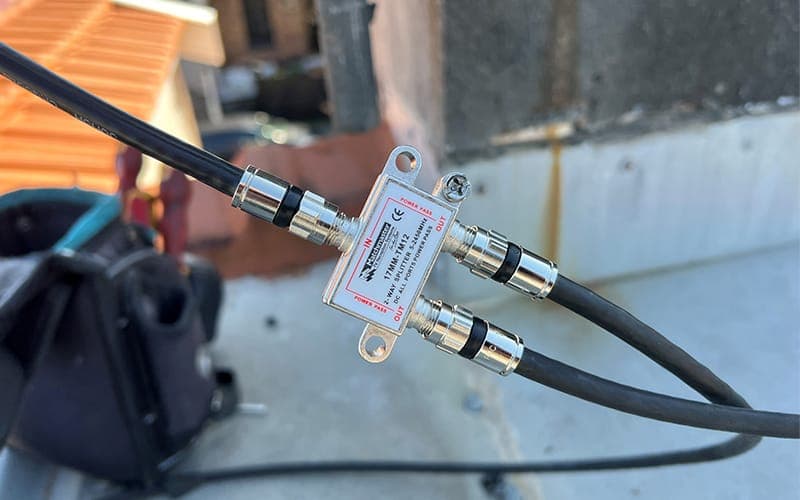
- The aerial is doing its job and the signal is being lost on the way down. That is a repair: a corroded connector, a splitter feeding more outlets than the signal can carry, or old coax that leaks along its length. A new antenna would leave the picture exactly as bad as it is now.
- Poor at the antenna
- Now the antenna is a genuine suspect. It may be damaged, aimed a few degrees off after a storm, or simply the wrong antenna for the suburb. This is the only one of the four results where replacement belongs in the conversation.
- Fine on the day, gone in the rain
- Water is getting into a joint, almost always an F-connector at the mast or in the roof space that was never weatherproofed. It reads well on a dry afternoon, which is exactly why it gets misdiagnosed. A repair, provided someone finds the joint.
When a new antenna genuinely is the answer
Replacement is the right call often enough that it should never be ruled out, and there are three situations where it is.
- Age, read against where you live. Ten to fifteen years is an ordinary life inland. Within a few kilometres of the water it is considerably less, because salt gets into the element crimps and the balun. On a coastal roof an antenna that would be middle-aged in Parramatta can be finished.
- Physical damage you can point to: bent or missing elements, a cracked balun, a mast that has rotated on its bracket. A meter confirms it, but you can usually see it from the ladder.
- The wrong antenna for the address. Sydney's networks all come from the same cluster of towers on the lower North Shore, so the question is how far away you are. Out west a house can need more gain and more height. Close in, a high-gain antenna can overload the tuner and break up the picture just as a weak signal does. Fixing that means a different antenna, sometimes a smaller one.
Where it does come to a new antenna, that is digital TV antenna installation, chosen from the reading at your roof rather than from a standard kit.
Five questions to ask any antenna installer
These work whoever you call, including us. A good installer answers all five without hesitating, because they are describing what they already did.
- Did you meter it at the antenna and at the wall plate? Both, not one. A reading at the roof alone cannot tell a cable fault from a healthy system.
- What were the readings? You do not need to interpret them. You need to know they exist and that the recommendation follows from them.
- Is the fault in the antenna or in the cabling? This is the question the two readings answer. If the answer is vague, the readings probably were not taken.
- Will an amplifier actually help at my address? Close to the transmitters it frequently makes things worse, and fitted behind the television rather than at the mast it amplifies the noise along with the signal.
- Is the price you just gave me the price I pay? A fixed quote before work starts is normal. A figure that only firms up once someone is on the roof is not.
Signs you are being sold the bigger job
None of these prove anything on their own, and plenty of honest installers have had a bad day. Two or more together are worth a second opinion.
- A new antenna recommended over the phone, before anyone has seen the roof or read a meter.
- An amplifier fitted in the lounge room to fix a picture that was breaking up only on ABC and Ten. Those two sit at the top of the band and are the first to go when a connector corrodes, and an amplifier does nothing about a corroded connector.
- The old antenna described as the fault, with the old connectors and splitters left in place under the new one.
- No readings offered, and none available when you ask.
Why the difference is worth money
A repair is usually a connector re-terminated, a splitter swapped for one sized to the house, or a run of old cable replaced, and the picture is back the same afternoon. A new antenna is all of the access and labour plus the hardware. Getting that call wrong in the expensive direction costs you the difference and leaves the actual fault in the roof. Getting it wrong in the cheap direction costs a second visit. The meter is how you avoid both.
Ray Anjoul has run Creative Sound & Vision since 1994 and goes to every job himself. Most of the antenna calls he takes end as repairs, and where the antenna really is finished you are shown the reading that says so.
If the picture is breaking up now, that is TV antenna repairs and fault-finding, metered at both ends before anything is replaced.
Common questions
The ones we get asked.
- Is it worth repairing an old TV antenna?
- If the reading at the antenna is good, yes, whatever its age. A sound antenna that is correctly aimed does not need replacing because a connector beneath it has corroded. Age matters when the reading at the antenna itself is poor, and on a coastal roof past about ten years that becomes likely rather than possible.
- How do I find a good antenna installer in Sydney?
- Ask how they diagnose before you ask what they charge. An installer who meters the signal at the antenna and at the wall plate, tells you the readings and gives a fixed price before starting is doing the job properly. One who recommends a new antenna over the phone is guessing.
- Can an electrician fix my TV antenna?
- Some do antenna work and do it well, but it is a separate trade from electrical. Antenna faults are signal problems rather than power problems, and finding them needs a signal meter, which most general electricians do not carry. Ask the same five questions whoever comes.
- How long does an antenna repair take?
- Most are done on the first visit, often within a couple of hours, because the common faults are a connector, a splitter or a section of cable. A new antenna takes longer, mainly because of roof access and running new cable.
- Why did the picture break up only on some channels?
- Because Sydney's five networks sit on different frequencies, and most of the ways an antenna system loses signal cost more at the top of the band. ABC and Ten usually go first. We have written that diagnostic up in full in the guide to no signal on a TV antenna.
What we do about it