
Guide
Home theatre design: the numbers that matter.
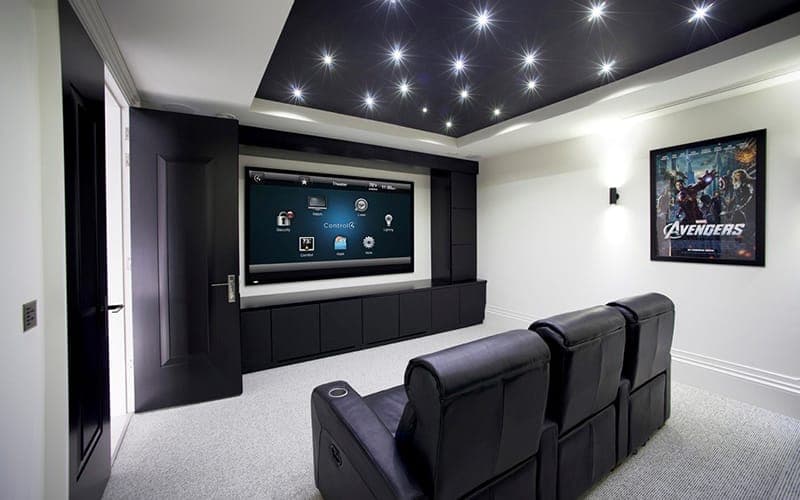
Most of home cinema design comes down to a handful of measurements, and getting them right costs nothing at the planning stage and is expensive to correct afterwards. This is what we work to, and where the published guidance comes from.
How far away to sit
For 4K screens, CHOICE publishes viewing distances of 105–180 cm for a 55-inch, 125–215 cm for a 65-inch and 145–250 cm for a 75-inch. Those three figures imply a consistent range of roughly 0.75 to 1.3 times the screen's diagonal, which is a useful way to extend the same guidance to whatever size you are actually considering.
The range exists because it is a preference, not a law. Closer fills more of your field of view and feels more cinematic; further back is easier for a room where people also talk to each other. What the numbers rule out is the common mistake in the other direction: a 55-inch screen at four metres, which is most of a suburban lounge room, and which is why so many people conclude they need a projector when what they needed was to sit closer or buy bigger.
How high to mount it
Eye level when seated, at the centre of the screen. That is usually much lower than people expect and much lower than a TV above a fireplace. Watching a screen mounted high means holding your head back for two hours, and it is the single most common regret we hear about an install someone did themselves.
Where a fireplace or joinery makes that impossible, a tilting bracket recovers some of it, and in a dedicated room tiered seating solves it properly by lifting the back row rather than lifting the screen.
Where the speakers go
- The centre speaker carries most of the dialogue. It goes directly above or below the screen, on the same axis as the screen's centre: not off to one side.
- Left and right sit at roughly 22 to 30 degrees either side of the seating position, with the tweeters near seated ear height.
- Surrounds go beside and slightly behind the seats, above ear height, angled in. They are not meant to be pointed straight at anyone's head.
- The subwoofer position is found, not assumed. Bass builds up in corners and cancels in the middle of a room, so the same subwoofer can sound excellent or nearly absent two metres apart.
The measurement most installs skip
The room's noise floor. How loud it is when nothing is playing. Decides how loud the system has to run before dialogue is intelligible. A room next to a main road, under a flight path, or with ducted air conditioning running has a much higher noise floor than the quiet room the specification assumed, and the result is a system that is either unintelligible or too loud, with no comfortable setting in between.
We measure it before specifying anything, because it changes the answer. It is also why two identical systems in two identical rooms can produce completely different verdicts from their owners.
Light, and why black paint is not the answer
Contrast is what makes an image look expensive, and ambient light destroys contrast faster than any equipment decision recovers it. Control the light first: block-out furnishings on the windows, no lamp facing the screen, and dimmable lighting rather than a single bright downlight circuit. Painting a room black helps a projector meaningfully and does very little for a TV, so it is worth knowing which you are building for before anyone buys paint.
Every decision above is one we make with you on site rather than off a specification sheet, which is what home theatre installation actually consists of: the room measured first, the equipment chosen second.
Free download
Planning a room before you call anyone?
Screen size for your viewing distance, seating rows, speaker positions and where the cable has to go before the walls close up. Worth reading whether you use us or not.
If you would rather just ask a question, call 0411 594 794. Quotes across Sydney metro are free.
Free download
The Home Cinema Room Planner
Is a 60 inch screen too big for my room? One page that answers it, for every size from 43 to 85 inches, plus seating distance and where to run cable before the walls close up.
Common questions
The ones we get asked.
- How big a TV should I get for my room?
- Work backwards from where you sit. CHOICE's 4K viewing distances put a 55-inch at 105–180 cm, a 65-inch at 125–215 cm and a 75-inch at 145–250 cm, which works out to roughly 0.75 to 1.3 times the diagonal. Measure the distance from the sofa to the wall first, and the size follows. Most people under-buy.
- TV or projector?
- Light control decides it more than budget does. A projector in a room you cannot darken will disappoint at any price, while a modern TV copes with ambient light well. If the room can be properly darkened and you want a genuinely cinema-sized image, a projector still gives you scale a TV cannot. If it cannot be darkened, buy the biggest TV the seating distance supports.
- Do I need acoustic treatment?
- In a dedicated room, some. Usually at the first reflection points either side and something soft on the floor. In a normal living room, furniture, rugs and curtains are already doing most of that work, and the bigger wins are speaker placement and finding the right subwoofer position. Treatment is worth doing after those, not instead of them.
- Can you design around joinery that is already built?
- Usually, yes, and it is most of what we do. The constraints are the screen's centre height against seated eye level and keeping the centre channel on the screen's axis. Where the cabinetry fixes the screen higher than ideal, a tilting bracket and careful speaker placement recover a good deal of it. It is worth having the conversation before the joinery is built if that is still an option.
What we do about it