
Guide
What a TV antenna install actually costs in Sydney
A straightforward TV antenna install in Sydney, or aerial install if that is the word you grew up with, sits inside a band most of the trade would agree on. What decides where your particular job lands in that band is almost never the antenna itself. It is how far you are from the North Shore transmitters, what your roof is made of and how you get onto it, and whether the signal arriving needs help once it is inside the house.
A repair, not a renovation.
We do high-end cinema rooms, and the pictures on this site show it — but an antenna fault is a call-out, not a project. Here is what you get either way.
Competitive
Most faults are a cheap fix.
The commonest fault by a distance is a corroded connector, and it is the cheapest thing on the list. We price the repair before anyone talks about a new antenna.
Fast
Same-day, seven days.
Antenna faults are the work we keep same-day capacity for. Ring 0411 594 794 and you get Ray, not a call centre.
Quality
Licensed, insured, warranted.
Fully licensed and insured, with a warranty on every job. A Sydney business that has been doing this since 1994.
Most quotes people are given are a single number with nothing behind it, which makes them impossible to compare. Two installers can quote the same job three hundred dollars apart and both be reasonable, because one has priced a bracket on a single-storey tile roof and the other has priced a mast, a masthead amplifier and a second point. It is worth knowing which parts of the job carry the money before you weigh one quote against another.
Where the money actually goes
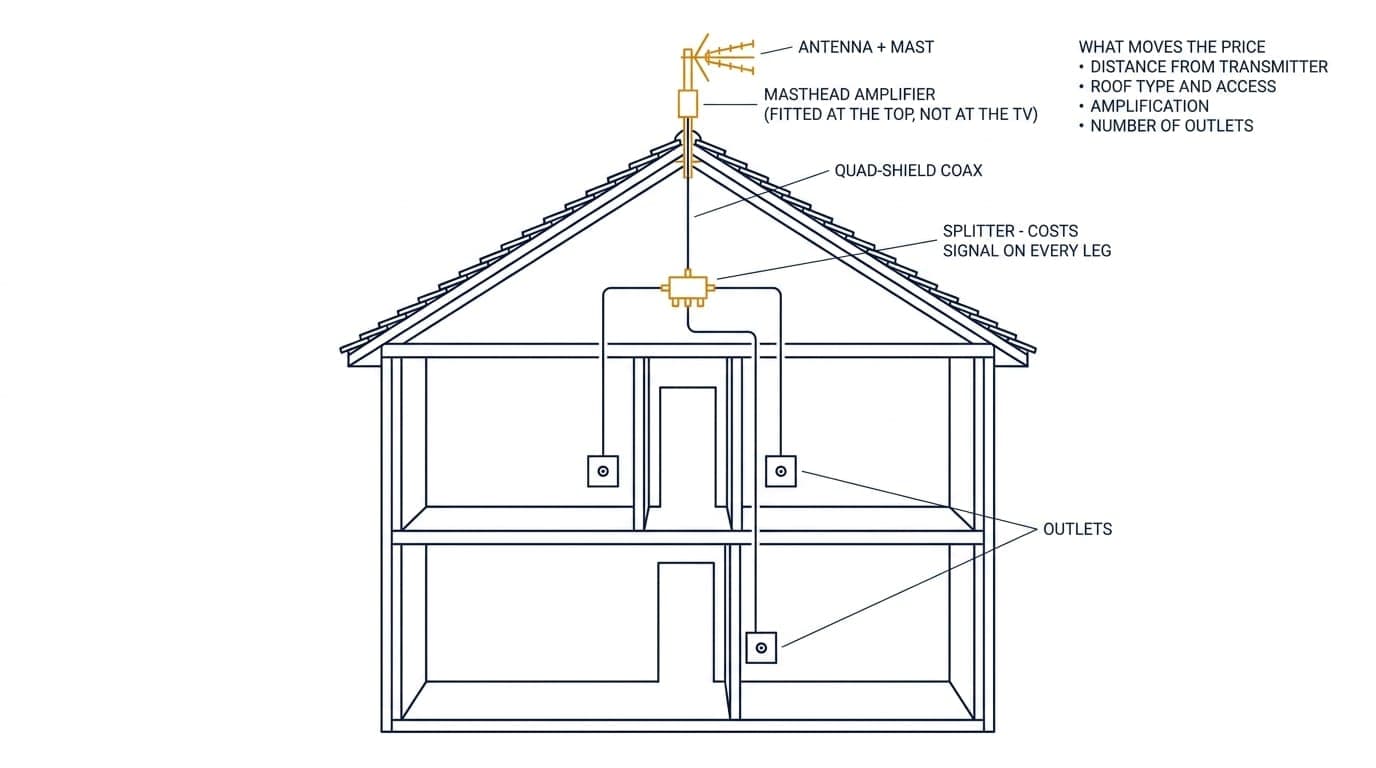
On a typical domestic install the hardware is the smaller half. An antenna, a mast or a wall mount, twenty to thirty metres of quad-shield coax, crimped F-connectors and a wall plate do not add up to much on their own. The labour is the rest of it, and the labour is mostly access and testing: getting safely onto a roof, finding a mounting point that is both structurally sound and clear of the ridge line, running cable through a roof space that may be 50 degrees in February, and then metering the result at the wall plate rather than guessing from the picture.
That last part is the bit that separates a job that holds up from one that comes back. An antenna that is roughly right will give you a picture on a clear day in April. Whether it still gives you one in a July southerly depends on how much margin was left in it, and margin is only visible on a meter.
The five things that move the price
- How far you are from the transmitters
- Every free-to-air channel in Sydney comes off three towers within about a kilometre of each other at Artarmon, Willoughby and Gore Hill. Inner-city, inner-west and lower-north-shore homes have signal to spare, so a modest antenna on a short mast will do. Out through Parramatta and the Hills there is measurably less arriving, and the job grows a higher-gain antenna, often more mast, and sometimes a masthead amplifier. Same antenna, same installer, materially different price, and the deciding factor is your postcode rather than anything you chose.
- The roof, and how you get onto it
- A single-storey Colorbond roof is the cheap end: quick to anchor, safe to walk, fast to leave. Tile is slower because every step is a potential cracked tile and the fixings are different. Steep pitches, second storeys and the slate roofs common through the inner west and the eastern suburbs all add time, and some of them add a harness or a second person. This is usually the single largest swing on an otherwise identical job.
- Whether the signal needs help, and where that help goes
- A masthead amplifier is a modest part cost and it is fitted at the antenna, not at the TV, because amplifying at the wall multiplies the noise the cable run has already picked up. If your job needs one, it needs it at height, which means it is fitted while someone is already on the roof rather than as a later visit. Worth getting decided at quote stage for that reason alone.
- How many points, and whether cable already exists
- One outlet is one cable run. A second and third outlet means a splitter, which costs signal at every leg, and it often means the antenna and the amplification have to be specified for the whole house rather than for one television. Where there is existing cable in the walls it can sometimes be reused, which is cheap. Where the existing cable is the thin black stuff from the analogue era, reusing it is a false economy and any honest installer will tell you so on site.
- House or apartment
- A freestanding house is yours to decide about. In a unit the roof is common property, and a private antenna on it generally needs owners corporation approval whatever the strata by-laws say about aerials. Most Sydney blocks already run a master antenna feeding a wall plate in every unit, and where that system is healthy it will beat anything installed privately. The useful money in an apartment is usually spent metering the wall plate to work out whether the fault is inside your unit or in the building's system, because those two have very different owners and very different bills.
What the Sydney market charges
Advertised prices across Sydney installers for a standard new rooftop antenna or aerial on a single or double-storey home cluster roughly between three hundred and eight hundred dollars, with additional TV points commonly quoted somewhere between eighty and three hundred dollars each depending on the wall type and the length of the run. Treat those as the shape of the market rather than a quote. They are the numbers businesses put on their own websites, which means they describe the easy version of the job, and the spread between the bottom and the top of that range is exactly the five factors above.
A number well under that range usually means something has been left out rather than that someone is being generous. The common omissions are the mast, the amplifier, the second outlet and the return visit when it does not hold up in weather.
Why nobody can give you an exact figure on the phone
Not because it is a sales tactic. Because two of the five factors above are unknown until someone is at the property. Nobody knows how much signal is arriving at your roof until it is measured there, and nobody knows what is under your tiles until they are on them. What can be settled on the phone is the shape of it: your suburb sets the likely antenna and whether an amplifier is in play, your roof type and storeys set the access, and the number of televisions sets the rest. That is usually enough to give you a range you can plan around, and to tell you which end of it you are likely to land.
When you are ready for the actual number, that is digital TV antenna installation, quoted after the roof has been metered rather than estimated from the street.
Common questions
The ones we get asked.
- Is a TV aerial the same as a TV antenna?
- Yes. Aerial is the older word and plenty of Sydney households still use it, but an aerial installer and an antenna installer are doing the same job at the same price. The distinction that actually matters here is the type. All five Sydney free-to-air networks broadcast on VHF Band III, so the right aerial for most Sydney homes is a VHF one. A UHF-only aerial, the kind often sold as a cheap one-size-fits-all option, will struggle here no matter how carefully it is aimed.
- Is a more expensive antenna a better antenna?
- Up to a point, and then it stops mattering. What you are paying for in a good antenna is the materials rather than the reception: marine-grade aluminium and a properly potted balun survive Sydney's salt air, and a cheap antenna in Bondi or Manly can be visibly corroded in three years. What a dearer antenna will not do is fix a siting problem. An ordinary antenna in the right place beats an expensive one in the wrong place every time.
- Can I just reuse the antenna that is already up there?
- Sometimes, and it is always worth checking before replacing. Plenty of Sydney antennas are mechanically fine and simply pointing slightly wrong, or are fine at the antenna and failing at a corroded connector below it. That is a repair rather than an install and it costs accordingly. The ones not worth saving are the old combination UHF and VHF arrays with half their elements gone, and anything where the balun housing has split and let water in.
- Does it cost more to install on a tile roof?
- Usually a little, yes. Tile is slower to work on than sheet metal because the fixings are different and because every step has to be placed on the supported part of the tile. It is not a large premium on a single-storey house. It becomes one on a steep second-storey pitch, where the access itself becomes the job.
- Why do I need an amplifier when my neighbour does not?
- Signal does not stop at a property boundary, but it does drop off with distance and it is blocked by terrain, and two houses on the same street can sit either side of a ridge line. The other common cause is inside the house rather than outside it: a home split three or four ways has spent signal your neighbour with one television has not. That is why the decision is made on a meter reading at your wall plate and not on what worked next door.
- Should I get three quotes?
- Get two, and make them explain the difference rather than just the total. Ask each what antenna they are fitting, whether the price includes a mast, whether an amplifier is needed and where it goes, and whether the quoted figure covers coming back if it drops out in weather. A quote that answers those questions and is dearer is usually the cheaper job in the end.
What we do about it