
Guide
Do indoor TV antennas work in Sydney?
Short answer: sometimes, and it is predictable which. An indoor antenna gives up the two things that make a rooftop antenna work. Height and a clear line to the transmitter, so whether it succeeds is decided by where you live and what your walls are made of, not by which one you buy.
A repair, not a renovation.
We do high-end cinema rooms, and the pictures on this site show it — but an antenna fault is a call-out, not a project. Here is what you get either way.
Competitive
Most faults are a cheap fix.
The commonest fault by a distance is a corroded connector, and it is the cheapest thing on the list. We price the repair before anyone talks about a new antenna.
Fast
Same-day, seven days.
Antenna faults are the work we keep same-day capacity for. Ring 0411 594 794 and you get Ray, not a call centre.
Quality
Licensed, insured, warranted.
Fully licensed and insured, with a warranty on every job. A Sydney business that has been doing this since 1994.
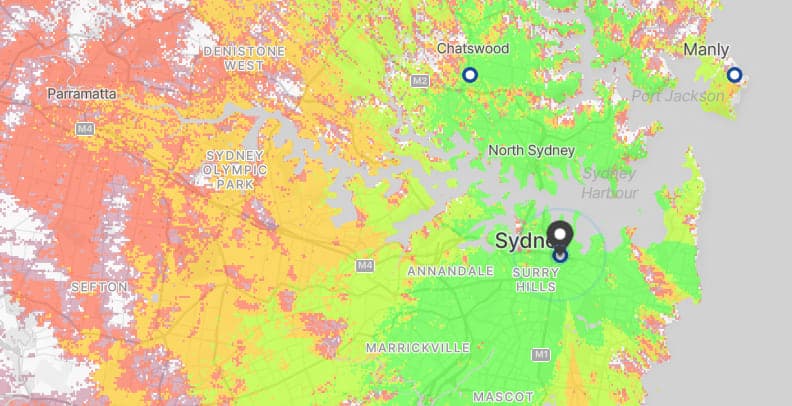
Almost every free-to-air channel in Sydney is transmitted from Artarmon on the North Shore. An antenna's job is to see that one point as clearly as possible. A rooftop antenna is put where it can: up high, above the roof line, pointed at Artarmon, with nothing in the way. An indoor antenna is on a shelf, below the roof, behind a wall, and often on the wrong side of the house entirely.
Where an indoor antenna has a real chance
- You are close in: the inner suburbs, the inner west, the lower north shore. Where the signal arriving is strong to begin with.
- You are on a middle or high floor of an apartment building, not the ground floor.
- You have a window facing roughly towards Artarmon, and the antenna can sit near it.
- Your building is brick or timber rather than a modern build wrapped in foil.
Where it will not work, and why
- You are out west
- Parramatta is about twenty-five kilometres from the transmitters and the Hills estates are further again. There is measurably less signal arriving at the building before anything gets in its way. Indoors, with the roof and a couple of walls to get through as well, there is usually not enough left. This is the single most common reason an indoor antenna disappoints someone.
- Your roof has foil sarking
- Most homes built or re-roofed in the last twenty-five years have a reflective foil membrane under the tiles or sheeting, and many have foil-faced insulation in the walls too. It is a thin sheet of metal across the whole building, and it is very good at stopping the signal reaching anything underneath. If your house has it, an antenna in the roof space or a room below is fighting an aluminium screen. This one surprises people because the house is new and everything else about it is better.
- You are on the ground floor with towers around you
- In Parramatta CBD, Chatswood or the city, the signal arrives having bounced off surrounding buildings as well as directly. Those copies arrive at slightly different times, and a digital tuner handles a certain amount of that and then falls over completely, which is why the picture goes from fine to blocks with nothing in between.
- You are in a gully
- Through the Hills and the northern suburbs the terrain does the blocking. If the ridge between you and Artarmon is higher than your roof, no antenna indoors or out will see through it. The fix is height and siting, and it has to be judged at the property.
Test before you buy
Indoor antennas are cheap enough that most people buy first and find out second. There is a better order. If a neighbour has one, ask what they get. If you are in an apartment, ask whether the building has a master antenna system already. Most blocks do, and a wall plate fed from a proper rooftop array will beat any indoor antenna in the building. And if you do buy one, buy it somewhere with a returns policy and try it in several positions near a window before you decide it does not work.
What an indoor antenna cannot do is turn a weak signal into a good one. An amplified indoor antenna amplifies the noise along with everything else, which is why the ones sold on the strength of a built-in booster so often perform no better than the ones without.
When it is worth calling someone
If you are renting and cannot touch the roof, an indoor antenna or a wall plate from the building's system is the whole of your options, and it is worth knowing which before you spend anything. If you own the place and the indoor antenna has not worked, the answer is nearly always height. That is a rooftop antenna, sited and metered, and in most of Sydney it is a single visit.
That is the job on the other side of this page: digital TV antenna installation, metered on the roof so the antenna is aimed at the signal that is actually there rather than the one the map predicts.
Common questions
The ones we get asked.
- Will an amplified indoor antenna fix bad reception?
- Usually not. An amplifier multiplies whatever it is given, signal and noise together, so on a weak and noisy indoor signal it makes the noise louder without making the picture better. Amplification helps when the signal is weak but clean, which is far more often the case at a rooftop antenna than at a shelf in the lounge room.
- Why does my indoor antenna work on some channels but not others?
- The channels are transmitted at different frequencies and power levels, so the weakest ones drop out first. Partial reception is the normal early sign that there is not quite enough signal, rather than a fault with one particular station. It also tends to change with the weather, which is a good clue that the margin is thin.
- I live in an apartment. Do I need my own antenna?
- Almost certainly not. Nearly every block runs a master antenna on the roof feeding a wall plate in each unit, and that will outperform anything you can put indoors. If your wall plate gives nothing, the fault is worth metering before you buy an antenna: it may be inside your unit, or it may be the building's system, and those have very different owners.
- Does foil insulation really block TV signal?
- Yes, and noticeably. Reflective foil sarking under the roof and foil-faced wall insulation form a continuous metal layer across the building. It is doing its job. Reflecting radiant heat, and blocking the broadcast signal is a side effect. It is the main reason an antenna in the roof space of a newer home performs so much worse than one above it.
What we do about it