
Guide
No signal on your TV? Which channels you lost tells you why
A television that says No Signal is not telling you much. What is genuinely diagnostic is which channels went and which stayed, because Sydney's five networks are transmitted at five different frequencies, and the faults that cause them fail do not affect those frequencies equally. Before anyone climbs a ladder, the pattern of what you have lost will usually narrow it to one or two causes.
A repair, not a renovation.
We do high-end cinema rooms, and the pictures on this site show it — but an antenna fault is a call-out, not a project. Here is what you get either way.
Competitive
Most faults are a cheap fix.
The commonest fault by a distance is a corroded connector, and it is the cheapest thing on the list. We price the repair before anyone talks about a new antenna.
Fast
Same-day, seven days.
Antenna faults are the work we keep same-day capacity for. Ring 0411 594 794 and you get Ray, not a call centre.
Quality
Licensed, insured, warranted.
Fully licensed and insured, with a warranty on every job. A Sydney business that has been doing this since 1994.
Sydney is unusual among Australian capitals in that all five free-to-air networks are broadcast on VHF Band III rather than UHF, from three towers clustered within about a kilometre of each other on the lower North Shore. For aiming purposes that is effectively one direction. For fault-finding it is five separate frequencies, and that is the part worth knowing.
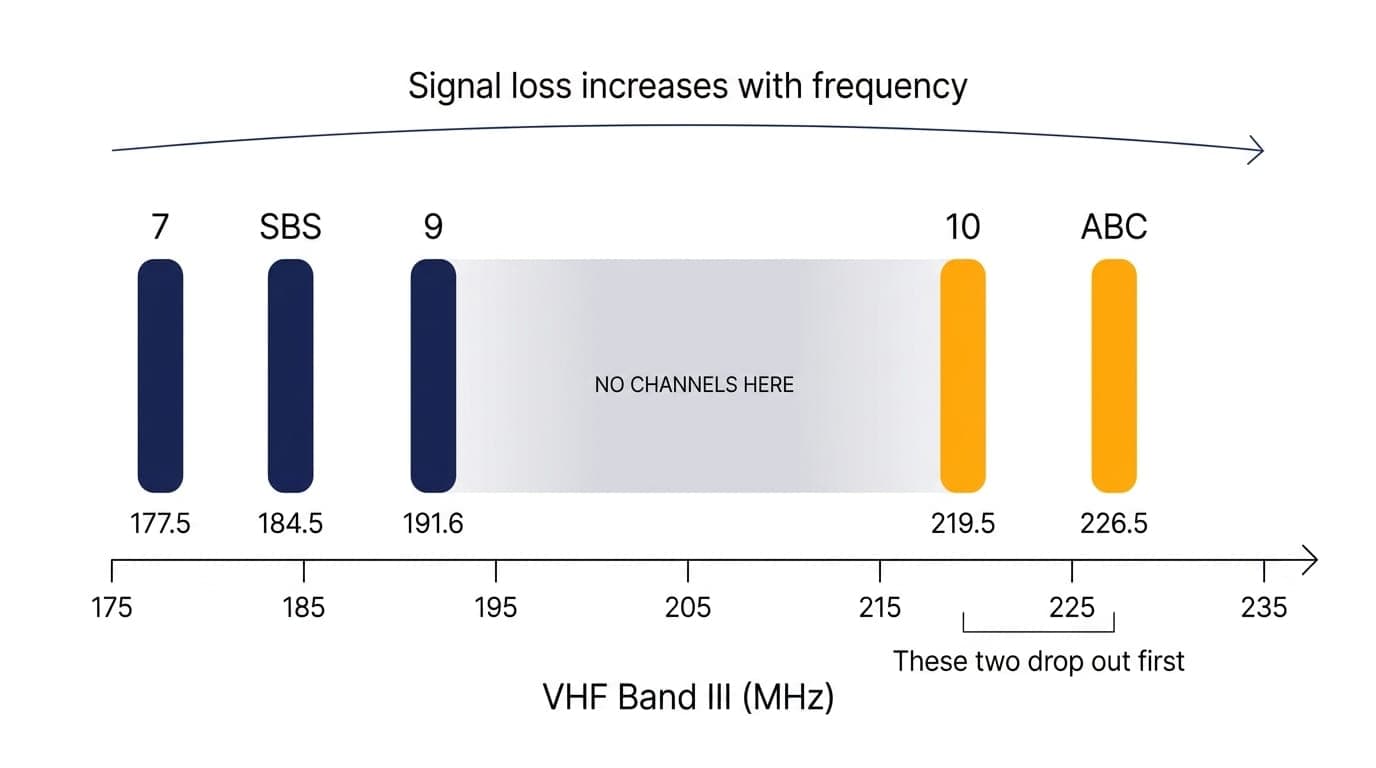
- Seven, 177.5 MHz
- Transmitted from Willoughby. The lowest frequency of the five.
- SBS, 184.5 MHz
- From Artarmon.
- Nine, 191.6 MHz
- From Artarmon. The top of the lower group.
- Ten, 219.5 MHz
- From the ABC tower at Gore Hill, and the start of the upper group.
- ABC, 226.5 MHz
- Also Gore Hill, and the highest frequency in the Sydney line-up. All five run at the same 50 kW, so when one network drops and another holds it is not because one is transmitted more weakly.
Note the gap. Seven, SBS and Nine sit between 177 and 192 MHz. Ten and ABC sit nearly thirty megahertz higher, at 219 and 226. Almost every loss mechanism in a domestic antenna system — corrosion, water in a connector, a long or tired cable run, an antenna losing elements, an amplifier past its life — costs you more at the high end than the low end. Which is why the failure so often looks like this: ABC and Ten go first, and everything else carries on as though nothing has happened.
What the pattern of loss tells you
- ABC and Ten gone, the rest fine
- The most common presentation in Sydney and the most informative. Something in the path is rolling off at the top of the band, and the usual suspects are a corroded connector, water that has tracked into the cable, a badly weathered antenna, or simply too much cable and too many splitters for the signal you started with. It is very rarely the television, and re-tuning will not bring them back for long because the margin is gone rather than the memory.
- Seven gone, the rest fine
- Seven is the odd one out twice over: lowest frequency, and the only one from Willoughby rather than Artarmon or Gore Hill. The towers are close enough that aiming rarely singles it out, so a Seven-only fault more often points at something frequency-selective, and the usual answer is an antenna that is not well matched at the bottom of the band. Worth metering rather than guessing.
- Everything gone at once, no picture at all
- That is a break rather than a degradation. Somewhere the path is open or shorted: a fly lead pulled out behind the television, a wall plate with a broken tail, a cable chewed through in the roof space, a masthead amplifier whose power injector has died, or an antenna that has come off its mast in a southerly. The power injector is worth checking first because it is indoors, it has a light on it, and it fails more often than people expect.
- It breaks up when it rains, then recovers
- Water is getting somewhere it should not, and the classic location is an F-connector at the antenna or at a joint in the roof space that was never weatherproofed. Rain bridges the gap, the connection degrades, then it dries out and the picture returns. The tell is that it recovers rather than staying broken, and it will get worse each season until the corrosion becomes permanent.
- It is worse on warm evenings, especially in summer
- That is usually not your system at all. Temperature inversions over the coast let distant transmitters carry much further than normal, and a co-channel signal from outside Sydney arrives to compete with the local one. It affects whole streets, it lasts hours rather than weeks, and no amount of work on your roof will prevent it. If your neighbours have it at the same time, wait it out.
- It started when you added another television
- Then the house has run out of margin rather than developed a fault. Every split costs signal on all legs, so the third or fourth outlet is often the one that pushes the weakest channels below the threshold. Note what this means: the new outlet is not faulty, and neither is the old one. The distribution needs rethinking for the number of points, which is a different job from replacing an antenna.
Three things worth trying before you call anyone
- Re-tune the television, and do it as a full re-scan rather than an update. If a channel has moved or the set has kept a stale entry, this is the free fix, and it takes two minutes.
- Swap the fly lead between the wall plate and the television, and push both ends home properly. It is the cheapest component in the whole chain, it is handled more than anything else, and a loose or damaged one produces exactly the symptoms of a much more serious fault.
- If the house has more than one outlet, try the television on a different one. If the second outlet is clean, the problem is downstream of the splitter and the roof is fine. If every outlet is equally bad, it is upstream, which means the antenna, the cable from it, or the amplifier.
Those three cost nothing and they genuinely resolve a fair share of call-outs. What they also do, if they fail, is hand a useful answer to whoever comes next.
What you cannot settle from inside the house
Everything above narrows the fault. None of it measures anything. The number that decides the job is how much signal is actually arriving at your roof and how clean it is once it reaches the wall plate, and that needs a meter at both ends. It is also the reason a picture that looks fine is not proof the system is healthy: digital reception holds a perfect picture right up until it does not, so a system running on almost no margin looks identical to one running on plenty until the first bad weather of the season.
Where the checks above do not clear it, that is TV antenna repairs and reception fault-finding, metered at the antenna and at the outlet so the cause is found rather than replaced around.
Common questions
The ones we get asked.
- Why did only ABC and Ten disappear?
- Because they are the two highest frequencies in the Sydney line-up, at 226.5 and 219.5 MHz, and nearly every fading mechanism in an antenna system costs more at the top of the band than the bottom. A corroded connector, water in the cable, a long run, one splitter too many or a weathered antenna will all take those two first. It is the single most useful symptom in Sydney because it tells you the system is losing signal rather than broken.
- Will re-tuning fix it?
- It will if the channel list is stale, and it will not if the signal is genuinely weak. The quick way to tell them apart: if a re-scan brings the channels back and they drop out again within days or in the next rain, the tuning was never the problem. The signal is sitting on the threshold and the re-scan simply found it on a good afternoon.
- My neighbour has the same problem. Is it the transmitter?
- Occasionally, and it is worth ruling in before spending anything. Planned transmitter maintenance and genuine outages do happen, and so does the warm-evening interference described above. The distinguishing feature is that both affect a whole area at once and resolve on their own. A fault on your roof does not fix itself overnight.
- Can a booster fix no signal?
- Only if what you have is weak and clean, and it has to be fitted at the antenna rather than behind the television. An amplifier multiplies whatever it is given. Fitted at the wall it amplifies the noise the cable run has already collected along with the signal, which is why indoor boosters so often change nothing. Where there is no signal at all, there is nothing to amplify and a booster cannot help.
- How long should an antenna last in Sydney?
- Inland, fifteen to twenty years is ordinary. Within a few kilometres of the coast it is considerably less, because salt air attacks the aluminium elements and the brass in the connectors continuously. Bondi, Coogee, Manly and Cronulla are hard on hardware, and an antenna that would be middle-aged in Parramatta can be finished there. The connectors usually go before the antenna does.
What we do about it