
Guide
Do you need a dedicated room for a home cinema?
Most people asking this have a spare room and are wondering whether to commit it. The honest answer is that a living room done properly beats a small dedicated room done badly, and that the room is not what separates a good cinema from a disappointing one. What separates them is control over light, control over sound, and whether the seating can go where the speakers need it to.
A dedicated room is not a different quality of system. It is the same equipment with the compromises removed, and the value of removing them depends entirely on which compromises your living room actually imposes. Some rooms impose very few.
What a dedicated room genuinely buys
- Light you control instead of light you tolerate
- This is the big one and it is the reason projectors live in dedicated rooms. A projector needs darkness to produce contrast, and a west-facing living room at four in the afternoon has none. A room you can black out lets you use a projector at a screen size no television reaches. A room you cannot means a television, and a television is perfectly capable of being the right answer.
- Speakers where they should be, not where the sofa allows
- Surround speakers belong beside and slightly behind the seating, at roughly ear height. In a living room the sofa is usually against a wall, which puts the rear speakers somewhere between awkward and impossible. A dedicated room lets the seating sit forward of the back wall, and that single change does more for surround sound than any amount of extra equipment.
- One row, one purpose
- A living room has to work for television, for conversation and for people walking through it. Every one of those pulls the layout away from the cinema ideal. A dedicated room only has to do one thing, so nothing has to be traded.
- Noise, in both directions
- A room with a door keeps the film in and the household out. In an apartment or a semi it also keeps you on speaking terms with the neighbours, which is a real constraint on how loud a system can usefully be rather than a polite afterthought.
What a good living room setup can still do
Nearly all of it, and this surprises people. A large television handles ambient light far better than a projector ever will, so a bright room is an argument for a television rather than an argument against a cinema. Sound is mostly a placement problem rather than a budget problem, and a properly positioned five-speaker layout in a living room comfortably outperforms a badly positioned seven-speaker one anywhere. Seating distance can usually be fixed by moving the sofa rather than by moving walls.
The honest limit is contrast in daylight and surround placement behind the seating. If neither of those bothers you in practice, the dedicated room is buying you less than it costs.
The three questions that actually decide it
- When do you watch?
- If the answer is evenings, light control matters far less than it sounds, because you have it already. Daytime sport and weekend films with children are where an uncontrolled room starts to hurt.
- Can the seating move forward?
- Look at whether the sofa can sit a metre or so off the back wall without the room stopping working. If it can, a living room will get most of the way to a cinema. If the sofa is jammed against the wall and cannot move, that is the clearest single argument for a separate room.
- Who else needs the room?
- A room that also has to be a lounge will always be a compromise, and that is a reasonable thing to accept. It becomes unreasonable when the compromise is invisible until after the joinery is built, which is why this is worth deciding before anything is specified.
The version most Sydney homes end up with
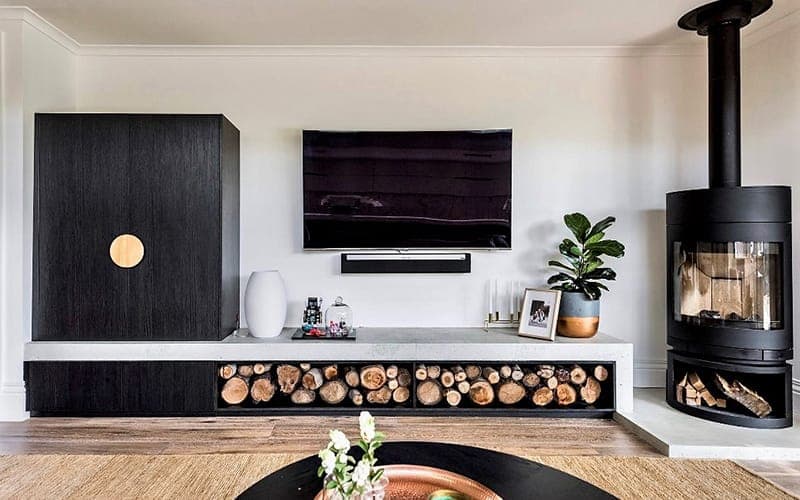
A large television in the main living space, done properly: sized and positioned for where people actually sit, with real speakers rather than the ones inside the screen, the subwoofer placed rather than hidden, and the cabling and boxes out of sight. It is not the compromise it sounds like. It is what most people wanted in the first place, and it gets used every night rather than on occasions.
Whichever of the two you land on, the work itself is home theatre and cinema installation, and the decision above is worth settling before any equipment is chosen.
Free download
Planning a room before you call anyone?
Screen size for your viewing distance, seating rows, speaker positions and where the cable has to go before the walls close up. Worth reading whether you use us or not.
If you would rather just ask a question, call 0411 594 794. Quotes across Sydney metro are free.
Free download
The Home Cinema Room Planner
Is a 60 inch screen too big for my room? One page that answers it, for every size from 43 to 85 inches, plus seating distance and where to run cable before the walls close up.
Common questions
The ones we get asked.
- Can you convert a garage into a cinema room?
- Often, and it is one of the better candidates because it usually has no windows and a door that closes. The two things to check before committing are insulation, because an uninsulated Sydney garage is unusable for half the year, and floor level, since seating geometry gets difficult if the ceiling is low.
- Is a projector always better than a television?
- No, and in a living room it is usually worse. A projector wins on size in a dark room and loses badly to a television everywhere else, because ambient light destroys contrast. If the room cannot be darkened, a large television is the better picture and not the consolation prize.
- How small can a dedicated room be?
- Small rooms work, but they constrain seating distance and they make bass behaviour harder rather than easier, because room modes get stronger as rooms get smaller. A narrow room with one row is usually a better outcome than a square one with two, and it is worth measuring before assuming the spare bedroom is the answer.
- We are renovating. Should we set a room aside?
- Decide it at the plan stage rather than after, because it changes where power, cable and doors go. Even if you choose against a dedicated room, running cable to the living room while the walls are open costs very little and keeps the option open later, when it would otherwise be expensive.
What we do about it