
Guide
Outdoor and alfresco home theatre.
The alfresco is the second most-watched screen in a lot of Sydney homes and the one most often got wrong. An indoor television moved outdoors fails in an entirely predictable sequence, and outdoor sound behaves so differently from a room that the speaker layout has to change too.
Covered alfresco areas are close to standard in newer Sydney homes, particularly through the Hills and the western growth suburbs. The pattern we see is the same each time: an indoor TV goes out there first, it works for a season, and the replacement conversation happens the following summer.
Why an indoor TV fails outside
- Condensation
- Sydney's overnight humidity puts moisture inside the housing of a set never sealed against it. It does not fail dramatically; it corrodes, and the failure arrives months later looking like an unrelated fault.
- Insects
- Warmth and an unsealed case is an invitation. Ants and spiders inside the panel are one of the most common causes of death for an indoor TV in an alfresco, and it is not covered by any warranty.
- It is simply not bright enough
- An indoor television is built for a lounge room and typically runs a few hundred nits. Outdoors, even fully shaded, the ambient light is an order of magnitude higher, and the picture washes out to a grey rectangle. Outdoor-rated screens run far brighter, and they are sold in full-sun, partial-sun and full-shade ratings precisely because this is the thing that decides whether you can see anything.
Outdoor sound is a different problem to indoor sound
This is the part that surprises people. Inside, a good deal of what you hear has bounced off a wall, a ceiling or a floor before it reaches you, and the room is doing some of the work. Outside there is nothing to reflect off. The sound leaves the speaker, reaches you directly, and keeps going.
The practical consequences: an alfresco needs more speakers than a room of the same size, spaced closer together, because there is no reflected sound filling the gaps between them. Bass suffers most, since there are no room boundaries reinforcing it, so a system that sounds full indoors sounds thin outside at the same settings. And turning it up is not the fix. It just moves the problem to the neighbours.
What an alfresco system actually needs
- A weather-rated screen matched to how much light the space actually gets, not the brightest one available.
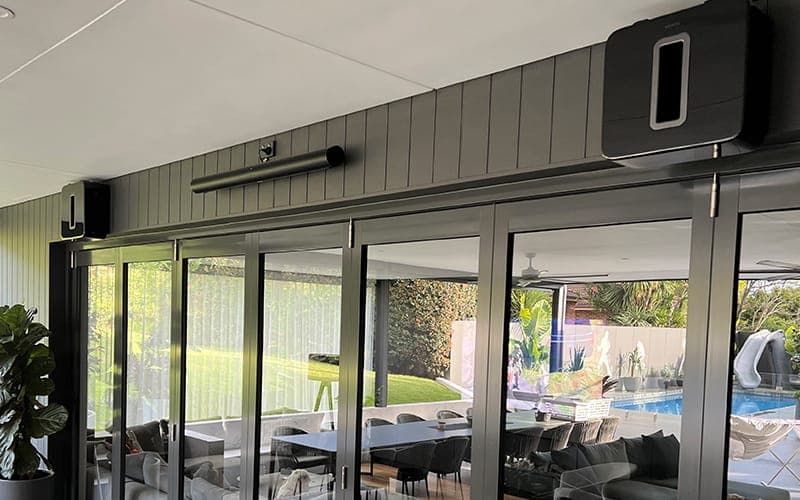
- IP-rated speakers, mounted under the eave and angled down towards where people sit rather than out across the yard.
- More speakers than you would use in the equivalent indoor room, because nothing is reflecting.
- UV-stable cable in conduit. Ordinary speaker cable in the open perishes in a few Sydney summers.
- A weatherproof outlet on an RCD, positioned so nothing is running off an extension lead through a door.
Do it at the frame stage if you can
If the alfresco is being built or renovated, the cable goes in before the lining does and the whole job becomes trivial. Retrofitting into a finished space is doable and we do it constantly, but it is the difference between an hour and a day. If you are at the frame stage, that is the moment to decide.
The screen still has to go on the wall at the end of it, and outdoors that usually means brick, render or stone rather than a stud wall. TV wall mounting on a hard exterior wall takes anchors into the substrate and the cable run planned before anything is drilled.
Common questions
The ones we get asked.
- Can I just put a normal TV under the pergola?
- You can, and plenty of people do, but plan on replacing it. Overnight condensation gets inside a case that was never sealed, insects follow the warmth in, and the panel is not bright enough for daylight even in shade. A weather-rated screen costs more once instead of an indoor set costing less repeatedly.
- How bright does an outdoor TV need to be?
- It depends entirely on where it goes. Outdoor screens are sold in full-shade, partial-sun and full-sun ratings, and the right one is decided by how much light reaches that specific spot at the time of day you actually use it. Buying the brightest available is a way of overspending; buying a shade-rated screen for a sunny corner is a way of wasting the whole purchase.
- Why does my outdoor speaker system sound thin?
- Because there is nothing outside for the sound to reflect off. Indoors the walls, floor and ceiling reinforce what you hear, particularly the bass. Outdoors that reinforcement is gone. The answer is more speakers placed closer to where people sit, rather than more volume from the ones already there.
- Will the neighbours hear it?
- Less than you would think, if it is done properly. Speakers mounted under the eave and angled down towards the seating put the sound where you are rather than broadcasting it across the fence, and because you are not fighting distance you can run it quieter. A single loud pair pointed out at the yard is what causes complaints.
What we do about it